
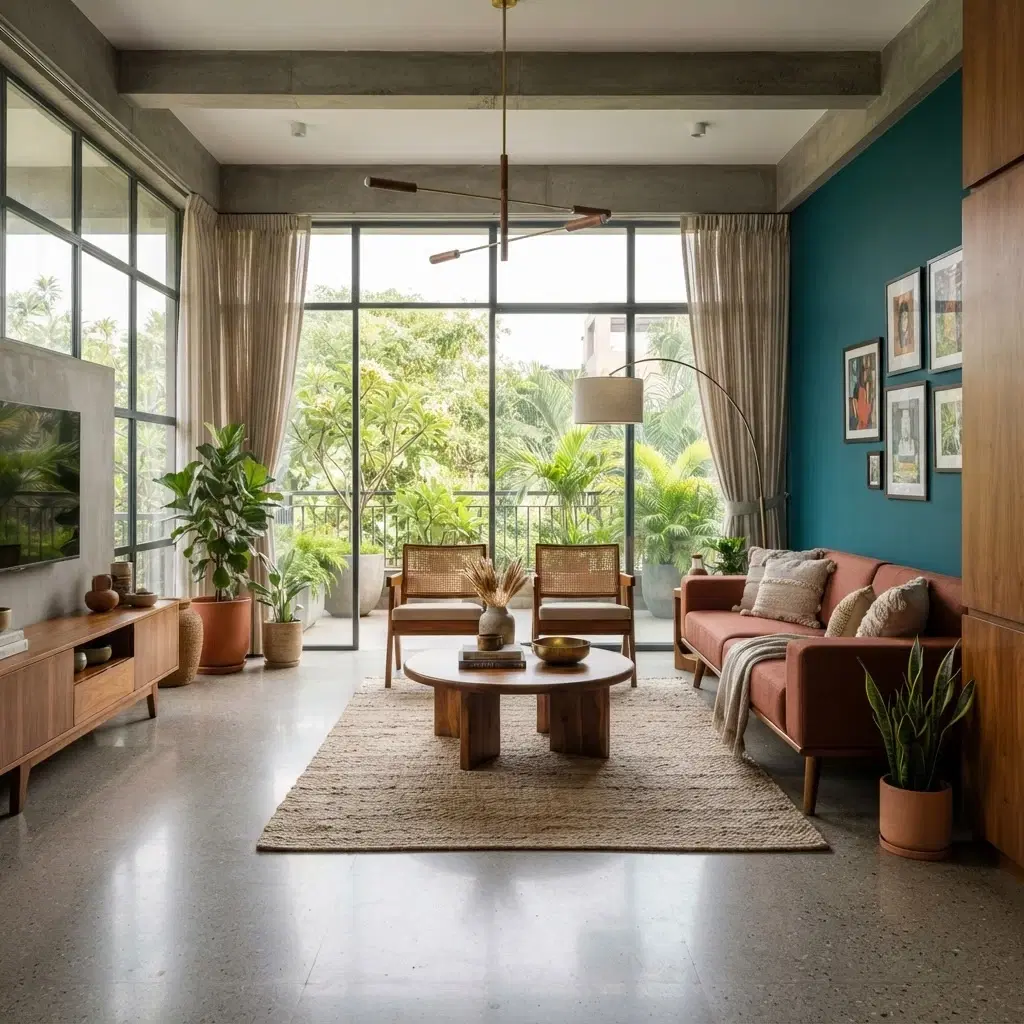
Warm neutrals have replaced cool grey
The grey-and-white palette that defined the last decade of Indian interiors has largely given way to warmer ground: oatmeal, clay, sand, and putty, with timber doing more of the work. It photographs less dramatically and lives considerably better, particularly in rooms that get hard afternoon light.
Where a client still wants contrast, it now tends to arrive as a single saturated element — a deep green kitchen island, an oxblood study wall — against an otherwise quiet room.
Fewer, better materials
The strongest interiors we have delivered this year use three or four materials, repeated with discipline, rather than a different finish in every room. It reads as considered rather than sparse, and it has a practical benefit most clients only appreciate later: matching a repair or an extension years on is straightforward.
Storage as architecture
Full-height joinery, flush with the wall and without visible handles, is now the default request rather than a premium one. It buys back floor area in apartments where every square foot is expensive, and it keeps the visual field calm.
- Wall-to-wall wardrobes with recessed handles instead of freestanding almirahs.
- Kitchen tall units that run to the ceiling rather than stopping short and collecting dust.
- Bench seating with storage beneath at dining and window nooks.
Lighting has finally been taken seriously
The single-ceiling-light room is disappearing. Layered lighting — ambient, task and accent on separate circuits — has moved from a designer's recommendation to something clients ask for by name. It is also the cheapest intervention on this list to get right at the wiring stage, and the most expensive to add afterwards.
What has faded
Heavily veined statement marble on every surface, open shelving in kitchens, and the all-white minimalism that never survived contact with Chennai dust. All three still appear in mood boards; noticeably fewer of them survive to the final drawing.